How Can I Find by Brush Again Inn Phtoshop

Photoshop'due south Brush Tool Subconscious Tips and Tricks
Learn undercover, pro-level tips and tricks for working with Photoshop'due south brushes and the Brush Tool, including faster ways to modify your brush size, choose brush colors, switch betwixt castor blend modes, and more! For Photoshop CC and CS6.
In this tutorial, I share hidden tips and tricks you lot can use with Photoshop'southward Brush Tool that make working with brushes faster and easier! I'thousand using Photoshop CC but these tips will also work with Photoshop CS6. Allow'southward become started!
Tip #1: Select the Brush Tool from your keyboard
This first tip isn't much of a secret but information technology'south even so a good one to know. Rather than selecting the Brush Tool from the toolbar, a faster fashion to select it is by pressing the letter B (for "Brush Tool") on your keyboard:
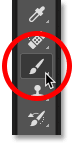
Press "B" to speedily select the Brush Tool.
Tip #2: Show the crosshair in the brush cursor
When using the Brush Tool, information technology oft helps to know the verbal center of your brush cursor so you tin encounter exactly where you lot're painting. You lot can show a crosshair in the center by enabling information technology in Photoshop's Preferences.
To open up the Preferences on a Windows PC, go upwards to the Edit menu in the Carte Bar. On a Mac, go up to the Photoshop CC card. From there, cull Preferences, and and then Cursors:
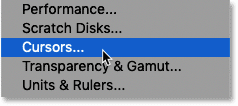
Opening the Cursors Preferences.
Select the option that says "Show Crosshair in Brush Tip" and then click OK to shut the dialog box:
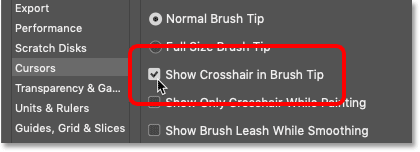
Selecting "Show Crosshair in Brush Tip"
The next time you paint with the Brush Tool, y'all'll meet a crosshair in the heart of the cursor:
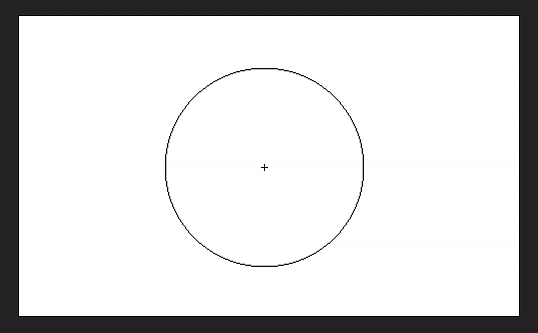
The crosshair marks the centre of the brush cursor.
Related: Get over 1000 more brushes in Photoshop CC!
Tip #iii: How to paint with smoother castor strokes
As you paint with the Brush Tool, y'all may notice that the edges of your strokes expect kind of "bumpy":
Photoshop's default brush strokes have bumpy edges.
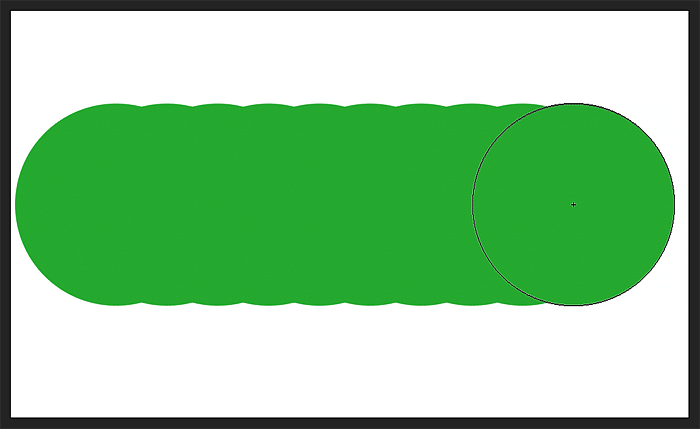
The reason is that Photoshop does not paint a continuous stroke. Instead, it paints past laying downwards a series of individual dots. And each 1 of those "bumps" in the stroke is a single dot. Past default, Photoshop spaces the dots too far apart, making them besides obvious. But nosotros can close up the spacing for smoother strokes, and we do that in the Castor Settings panel.
To open up information technology, get up to the Window menu in the Carte du jour Bar and cull Castor Settings. If y'all're using Photoshop CS6, the Castor Settings panel is chosen the Brush console:
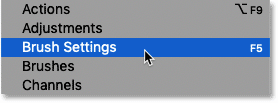
Going to Window > Castor Settings.
The Spacing option
At the bottom of the panel is the Spacing pick, along with a preview beneath it showing your brush stroke with your current settings. The default Spacing of 25% is too high. This value is a agree-over from years ago when computers were not as fast every bit they are today. Back then, smaller Spacing values would have slowed Photoshop downward. But if you're using a newer reckoner, at that place'southward no reason to keep this onetime setting:
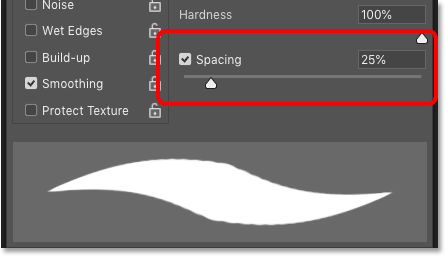
The default Spacing value for the castor stroke.
If we increase the Spacing value, we run across the private dots that make up the stroke:
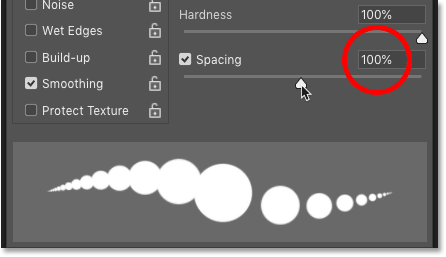
The dots become obvious at higher Spacing values.
Lowering the value back down to 25% does assistance, simply those bumps are still there. So these days, the best Spacing value to use is ten%. This gives you a much smoother and cleaner brush stroke without sacrificing speed and performance:
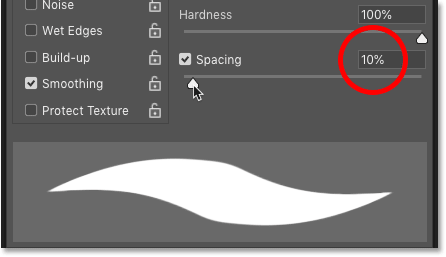
Lowering the Spacing to 10%.
I'll paint another stroke, and this time with the Spacing lowered to 10%, the edges look much smoother:
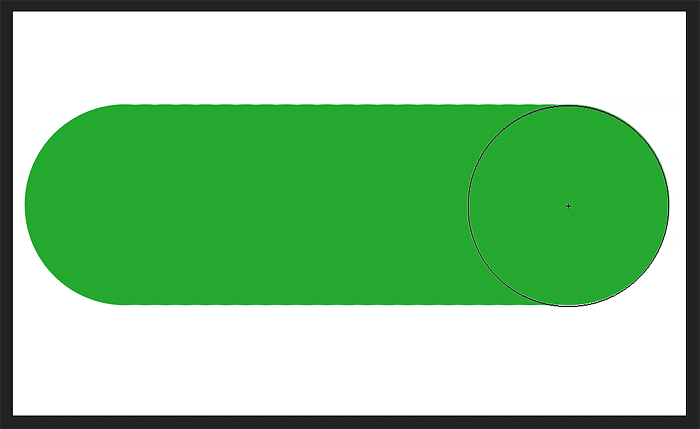
The lower Spacing value smooths out the edges.
Tip #4: Faster ways to alter your brush size
Next, let'due south look at some faster ways to alter the size of your castor.
The Castor Preset Picker
The nearly common way to change your castor size is by right-clicking (Win) / Control-clicking (Mac) in the certificate to bring upward the Brush Preset Picker. From here, you lot tin can drag the Size slider left or right to conform the castor size as needed:
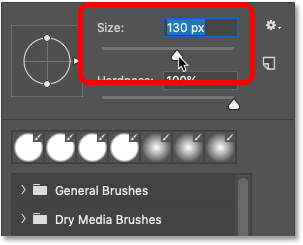
Changing the castor size from the Brush Preset Picker.
The bracket keys
But a faster way to change your castor size is by using the left and correct bracket keys ( [ and ] ) on your keyboard. You'll detect them next to the letter of the alphabet "P". Press the left bracket key ( [ ) repeatedly to brand your castor smaller or the right bracket primal ( ] ) to make it larger.
As you printing the keys, the size of your castor cursor changes. And in the Options Bar, you'll see the value for the current brush size updating:
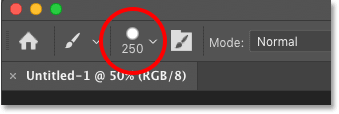
The current brush size is shown in the Options Bar.
The HUD (Heads Up Brandish)
The only problem with the bracket keys is that they brand your brush larger or smaller in incremental steps. Merely if you demand more command over your brush size, or if your keyboard does not include the bracket keys, y'all tin change the brush size using the HUD, or Heads Up Brandish.
To access the HUD on a Windows PC, printing and hold the Alt key on your keyboard and correct-click in the document. On a Mac, press and concord your Control and Option keys and left-click. Keep your mouse button held down and yous'll see the HUD showing a preview of your brush cursor, forth with its current size (Diameter), the Hardness of the brush, and the Opacity. Note that the red color y'all're seeing is non your castor color. It's merely the color of the brush preview, and I'll show you how to change it in a moment:
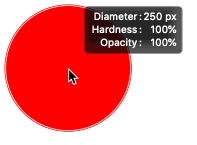
The HUD (Heads Up Brandish).
Once your mouse push button is downwards, y'all tin release the Alt key (Win) or the Command and Option keys (Mac). The HUD will stay open for as long as your mouse push button is held down. Then to adjust the castor size, drag left or correct. Dragging to the correct will brand the castor larger, and dragging to the left will make it smaller. Equally y'all drag, the size of the castor preview will modify and you'll see the Bore value updating:
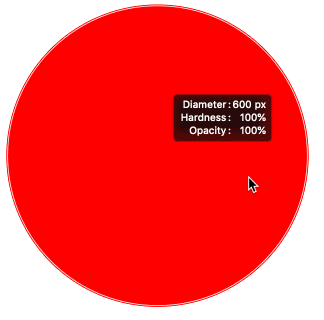
Drag left or correct with the HUD to change your brush size.
Tip #v: Changing the brush hardness with the HUD
Along with using the HUD to change your brush size, you lot can also use it to adjust the brush hardness. The current Hardness value is shown below the Diameter value. To decrease the hardness, keep your mouse push button held down and drag upwardly. Lowering the hardness makes the brush edges softer, and the softer the edges, the more feathering you lot'll see around the preview's outline. Or drag downwards to make the castor edges harder:
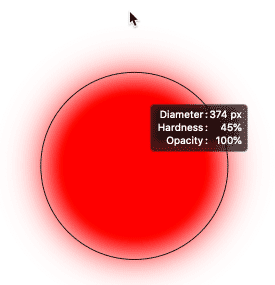
Elevate up or down with the HUD to change the castor hardness.
How to change the HUD'southward brush preview colour
If you don't similar the red colour of the brush preview, or it's hard to meet in front of your image, you can change the color in Photoshop's Preferences. A quick way to open up the Preferences is by pressing Ctrl+K (Win) / Command+One thousand (Mac) on your keyboard. And so in the Preferences dialog box, select the Cursors category on the left:
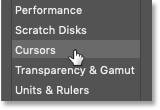
Selecting the Cursors preferences.
To change the preview color, just click the Brush Preview color swatch and choose a new color from the Colour Picker. Then click OK to close the Preferences dialog box:
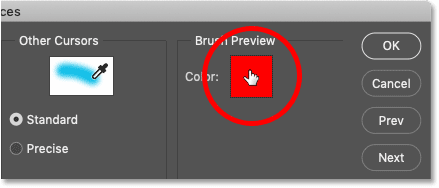
Click the Brush Preview color swatch to choose a new color.
Tip #6: Using the HUD Colour Picker
We've seen that we can change Photoshop'due south brush size and hardness using the HUD. But we tin can likewise use the HUD to quickly choose our brush colour, and to choose new colors as we pigment.
The current brush colour is shown in the Foreground color swatch in the Options Bar. And the most common style to change the brush color is to click on the swatch:
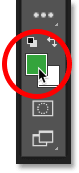
Clicking the Foreground color swatch.
And so choose a new color from the Color Picker:
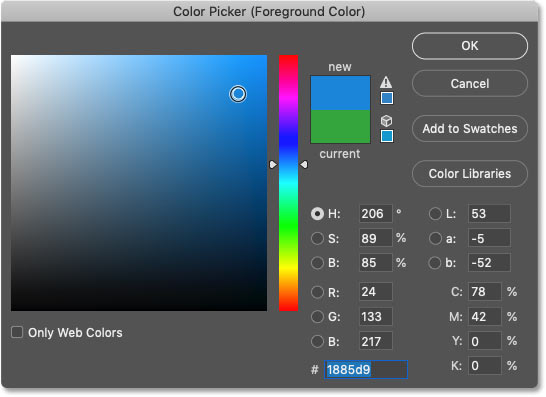
Choosing a new castor color from the Color Picker.
The HUD Color Picker
But the problem with choosing castor colors like this is that each time nosotros need a different color, we accept to take our eyes off our piece of work. A meliorate and faster mode is to employ the HUD Color Picker.
To open the HUD Color Picker on a Windows PC, press and hold your Shift and Alt keys and right-click in the document. On a Mac, press and hold the Command, Command and Selection keys and left-click.
This opens the default HUD Colour Picker, with a Hue strip along the right and what Adobe calls the Hue cube on the left. Once your mouse button is down, you tin release the Shift and Alt keys (Win) or the Control, Control and Option keys (Mac). The HUD Colour Picker volition stay open for as long as your mouse button stays downwards:
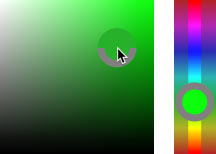
The default HUD Color Picker.
To choose a brush color, first elevate your mouse cursor into the Hue strip on the right, so drag upwards or down within the strip to select a hue, or the primary color:

Choosing a primary brush color from the Hue strip.
And then drag your cursor into the Hue cube on the left. Drag up or down within the cube to set the brightness of the colour, and drag left or right to set the saturation. Once you've chosen your colour, release your mouse button to close the HUD:
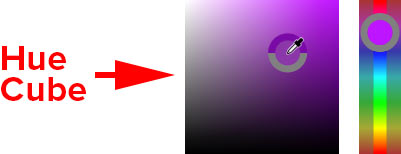
Setting the effulgence and saturation in the Hue cube.
How to choose a dissimilar HUD Color Picker
If yous find that the HUD Color Picker is too small, that'due south because Photoshop chooses the smallest version past default. But in that location are other sizes we can use, and fifty-fifty a different type of Colour Picker.
Printing Ctrl+K (Win) / Control+K (Mac) to open Photoshop'south Preferences. Then look for the HUD Colour Picker pick at the top. By default, it's ready to Hue Strip (Pocket-sized):
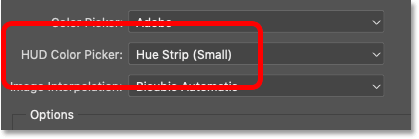
The HUD Colour Picker option in Photoshop'southward Preferences.
Click on the option to select a dissimilar size (Medium or Large) for the Hue Strip. Or you can switch to a Hue Wheel, with diverse sizes to cull from:
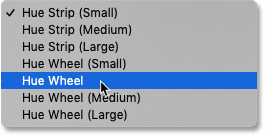
Setting the HUD Color Picker to "Hue Wheel".
The Hue Wheel works the aforementioned as the Hue Strip. Start by dragging your mouse cursor into the outer cycle to choose the chief color. Then drag into the cube in the center and drag up or down inside the cube to set up the brightness, and left or right to set the saturation:
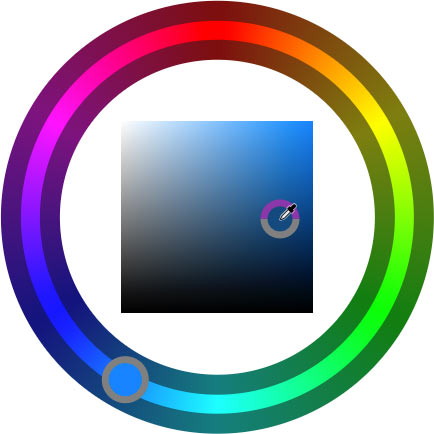
Choosing a color from the Hue Wheel.
Related: How to salve custom brushes in Photoshop CC!
Tip #7: A faster manner to cull brush blend modes
Finally, let's wait at a faster way to switch betwixt Photoshop'southward brush alloy modes. Along with layer blend modes, found in the Layers panel, which control how a layer blends and interacts with the layers beneath it, Photoshop also includes brush alloy modes. The brush blend modes are found in the Options Bar whenever a brush tool is agile:
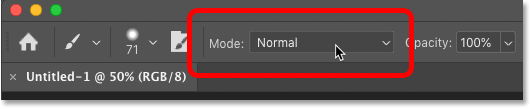
The castor blend modes in the Options Bar.
Brush blend modes control how the brush interacts with the layer, and how your brush stroke interacts with other castor strokes. Clicking the Alloy Way option in the Options Bar opens the complete list of blend modes for the brush tool, and most of them are the same as what you'd find in the Layers panel:
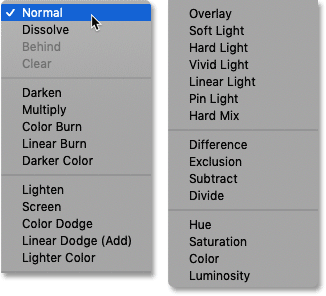
Photoshop's brush blend modes.
Simply rather than choosing them from the Options Bar, a faster way to switch betwixt brush blend modes as yous're working is past belongings your Shift primal and right-clicking in the document. Or on a Mac, hold your Shift and Control keys and left-click. Then choose the alloy mode you demand from the list.
For example, I'll paint an initial brush stroke using the default Normal blend mode:
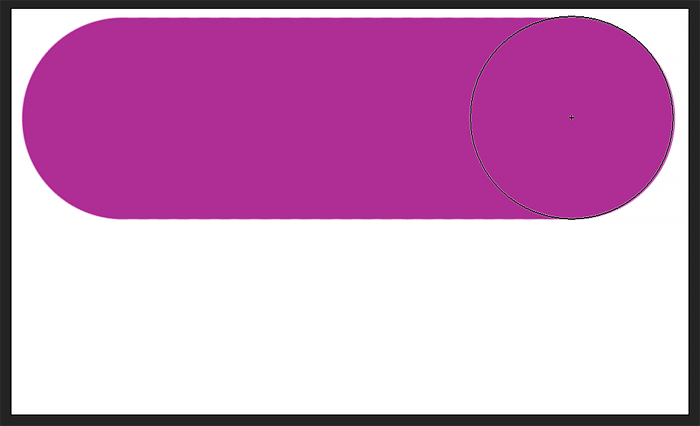
Painting a castor stroke with the blend style set up to Normal.
Then I'll leave the blend way set to Normal and I'll pigment a second stroke that partially overlaps the commencement one. But notice that all I'1000 doing is covering more area. The brush strokes are non interacting in any interesting style:
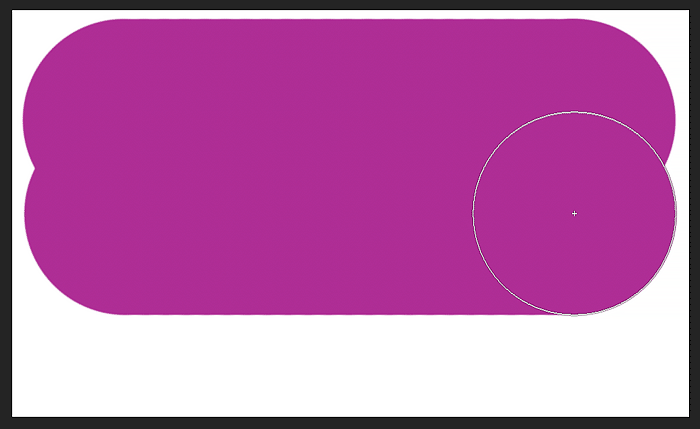
Painting a second stroke, also set to Normal.
I'll undo that last stroke by going up to the Edit bill of fare and choosing Undo Brush Tool, or by pressing Ctrl+Z (Win) / Control+Z (Mac) on my keyboard:
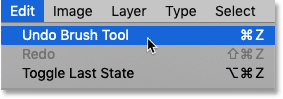
Going to Edit > Undo Brush Tool.
Painting with brush blend modes
And then I'll bring upward the list of castor blend modes by holding Shift and correct-clicking in the document. Or on a Mac, I would hold Shift+Control and left-click. Then from the menu, I'll choose the Multiply blend style:
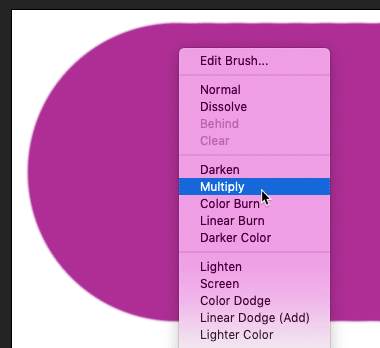
Selecting the Multiply brush blend mode.
The Multiply blend mode works the same manner with brushes as it does with layers. Information technology multiplies overlapping brush strokes together to create a darker effect.
I'll pigment another brush that overlaps the first one. And this time, with the blend fashion prepare to Multiply, the area that overlaps becomes darker:
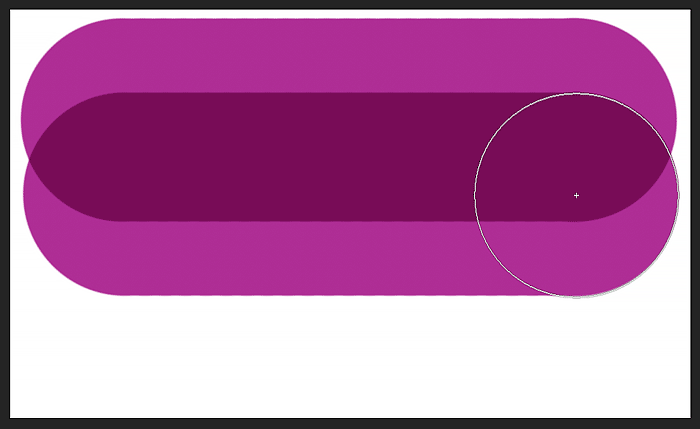
Multiply darkens overlapping castor strokes.
And if I paint a tertiary stroke, the area that overlaps the kickoff two strokes darkens fifty-fifty more:
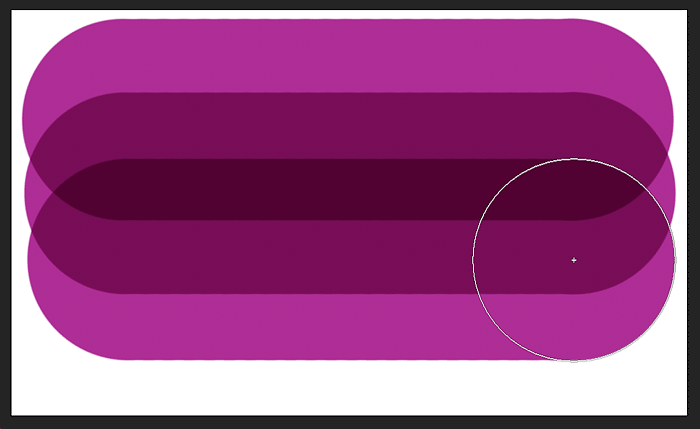
The effect grows darker as more brush strokes overlap.
Related: Photoshop Blend Modes Tips and Tricks
Resetting the brush blend way
When you're done with the brush, remember to set the blend mode back to Normal, otherwise you might go unexpected results the next time y'all use information technology:
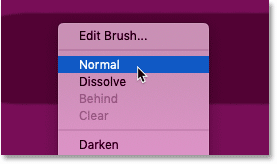
Setting the brush blend style back to Normal.
And in that location we have it! That'southward some hidden, time-saving tips and tricks yous tin can employ with the Brush Tool in Photoshop! Check out our Photoshop Basics section for more than tutorials. And don't forget, all of our Photoshop tutorials are available to download as PDFs!
Other Stuff
© 2022 Photoshop Essentials.com.
For inspiration, not duplication.
Site design past Steve Patterson.
Photoshop is a trademark of Adobe Systems Inc.
Source: https://www.photoshopessentials.com/basics/photoshop-brush-tool-hidden-tips-tricks/
Belum ada Komentar untuk "How Can I Find by Brush Again Inn Phtoshop"
Posting Komentar